Regulation & Standards, Quality & Testing, Design & Development
How the ISO 14971 Risk Management Standard Is Applied—and Where Medical Device Teams Struggle
Updated
Introduction
Medical device risk management is both a regulatory requirement and a practical necessity. ISO 14971 is the recognized international standard for this work, but effective ISO 14971 risk management implementation continues to present daily obstacles for development and quality teams. Changes in global regulatory frameworks, such as the EU MDR, have made compliant risk management more complex and raised expectations for benefit–risk analysis, post-market feedback, and cybersecurity. Ambiguity in guidance and inconsistency in terminology often lead to confusion, incomplete processes, or delays.
This article outlines the key stages of ISO 14971 application, highlights common technical stumbling blocks, and provides practical recommendations for teams integrating the standard into development and post-market activities.
ISO 14971 in the Device Lifecycle: The Essentials
ISO 14971:2019 sets out a systematic approach to risk management for medical devices, from design and development through production and post-production monitoring. The standard is harmonized with major regulations like the EU MDR and is an expectation for access to many global markets. Compliance is not optional for most device companies.
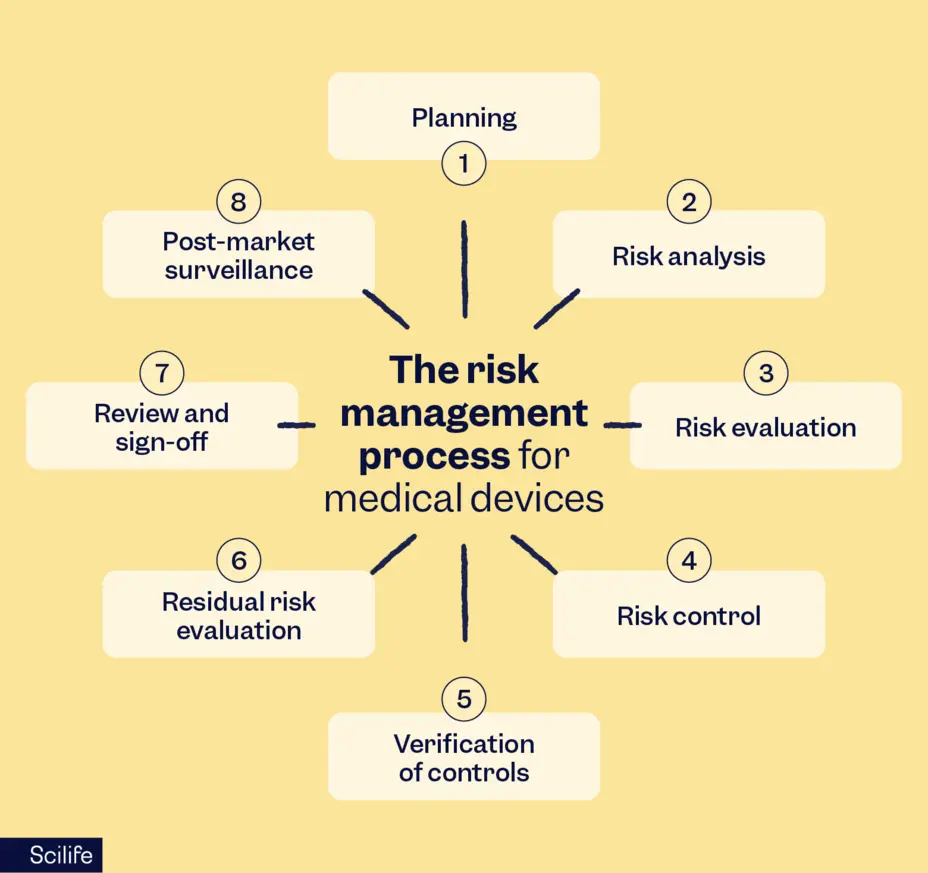
The process is summarized as follows:
- Risk Management Planning: Define the scope, stakeholders, responsibilities, methodologies, and risk acceptance criteria for the device or system.
- Risk Analysis: Identify hazards, estimate the probability and severity of harms, and determine hazardous situations using tools such as FMEA, FTA, or software-specific analyses.
- Risk Evaluation: Compare estimated risks to predefined acceptability criteria.
- Risk Control: Select and implement measures to reduce risk, with a preference for inherently safe design and protective measures over labeling alone.
- Residual Risk Evaluation: Ensure that after risk controls, the remaining (residual) risks are acceptable—or justify any that are not via benefit–risk analysis.
- Benefit–Risk Analysis: Weigh the clinical benefits of the device against remaining risks, both individually and overall.
- Risk Management Review: Confirm that the risk process is complete and the device remains within acceptable risk parameters.
- Production and Post-Production Information: Establish systems to collect, review, and act on risk-related information after launch, including feedback from all relevant sources.

Four Common Areas Where Teams Struggle
While ISO 14971 is conceptually clear, practical implementation regularly breaks down in four areas:
1. Ambiguity in Benefit–Risk Analysis
The challenge: Regulations have evolved to require more explicit benefit–risk assessments, not just for the overall device but for every identified risk, including those deemed acceptable after controls. However, the standard offers limited guidance on how to conduct or document such analyses, especially for non-quantitative data or novel technologies.
- Teams are often unclear about when benefit–risk analysis is mandatory (see below for USA vs. EU differences).
- Subjective assessments, inconsistent use of terminology (such as what constitutes ‘benefit’), and lack of traceability between clinical data and identified hazards create audit risks and compliance problems.
Key regulatory points:
- Under the EU MDR, a benefit–risk analysis is required for every individual risk and for overall device risk—not only when risks are unacceptable post-controls.
- The standard has moved away from ALARP (As Low As Reasonably Practicable) principles and financial considerations are not valid factors in determining acceptability under EU MDR.
Recommendation:
- Document clear policy on when and how to conduct benefit–risk analysis, referencing current regulatory requirements.
- Link risk management, design files, and clinical evaluation documents with explicit traceability.
- Use clinical literature, study data, and post-market feedback as direct inputs for weighing benefits and residual risks, and update this assessment routinely.
2. Integration of Post-Market Surveillance
The challenge: Post-market surveillance (PMS) is a formal requirement and must be linked to ongoing risk management. Yet companies often treat risk management as a one-time premarket activity or rely only on reactive mechanisms (complaint reporting) for feedback.
- Many teams lack systematic approaches for integrating proactive data sources (such as registry data, user feedback, or software performance logs) into risk files.
- Failing to update risk management based on field data leads to blind spots, audit findings, or missed design improvements.
Recommendation:
- Set up proactive PMS processes—continuously collect data from customers, field service, clinical studies, and adverse event databases.
- Regularly review risk files in the context of new data. Define clear triggers for risk reassessment or design changes.
- Ensure all risk management activities (including post-market actions) are documented and traceable.
3. Managing Cybersecurity and Software Risks
The challenge: As device connectivity and software content expand, manufacturers must manage new threat categories such as unauthorized access, data breaches, and software failures. ISO 14971 is often interpreted unevenly when dealing with cybersecurity, as it is not prescriptive or directly aligned with technical cybersecurity frameworks.
- There is confusion about how to characterize cybersecurity as a ‘hazard’, integrate it with traditional clinical risk, and ensure controls are evaluated effectively.
- Software as a Medical Device (SaMD) and digital therapeutics present unique challenges for risk estimation and control prioritization.
Recommendation:
- Treat cybersecurity threats as part of the hazard identification and risk assessment process.
- Reference relevant complementary standards (such as IEC 81001-5-1 or IEC 62304 for software) and link findings with ISO 14971 risk activities.
- Form multidisciplinary teams involving software engineers, IT security experts, clinicians, and regulatory staff for comprehensive risk identification.
- Include cybersecurity incident data as part of post-production feedback.
4. Inconsistent Interpretation of Key Terminology
The challenge: Terms such as ‘hazard’, ‘harm’, ‘risk’, and ‘hazardous situation’ are defined in ISO 14971, but these terms are still used inconsistently in many organizations.
- This inconsistency results in siloed documentation, errors in filling risk management files, and difficulty in cross-functional discussions or training.
- It impedes the tracing of risk controls—especially when design, manufacturing, and quality teams use different vocabularies or risk matrices.
Recommendation:
- Train all team members on the standard’s definitions and reinforce them in SOPs and templates.
- Use a single set of risk criteria and language across all projects and business units.
- Maintain traceability between each identified hazard and risk control in both development and post-market phases.
Key Practical Steps to Successful ISO 14971 Risk Management Implementation
Drawing from practical experience and current regulatory trends, the following actionable steps support more robust risk management:
1. Establish a Clear Risk Management Policy
- Define objectives, scope, acceptability criteria, and roles in a formal, controlled policy document.
- Reference current regulatory needs, including benefit–risk analysis requirements for your markets.
2. Use Structured, Documented Processes for Hazard Identification
- Apply tools like Hazard Analysis, FMEA, and FTA to systematically identify all potential hazards—including cybersecurity, usability, and foreseeable misuse.
- Include input from multidisciplinary teams and, where possible, use checklists for completeness.
3. Standardize Risk Assessment Methods
- Use documented, quantitative or qualitative scoring systems for both probability and severity. Ensure criteria are applied consistently across products and teams.
4. Prioritize Risk Controls According to ISO 14971 Hierarchy
- Favor inherently safe design changes first; use protective measures second; warnings and labeling only as a last resort.
- Document the rationale for selected controls and their verification/validation.
5. Maintain a Thorough, Auditable Risk Management File
- The risk management file is not just a document for regulatory review—it is the living record of all risk management activities and decisions.
- Ensure it includes links to design history, clinical evaluation, PMS reports, and CAPA records.
6. Make Post-Market Feedback a Built-In Process
- Integrate complaint data, field performance, recalls, and user feedback directly into routine risk reviews.
- Update risk analysis and controls accordingly, and document changes and rationale clearly.
7. Foster Alignment and Communication Across Functions
- Address organizational silos with standardized procedures, shared terminology, and regular risk review meetings including R&D, quality, regulatory, service, and post-market surveillance experts.
Table: Common Implementation Gaps and Solutions
| Challenge | Common Pitfall | Practical Solution |
|---|---|---|
| Benefit–Risk Analysis | Vague or inconsistent justification | Define policy, use traceability, update routinely |
| Post-Market Surveillance Integration | Reactive feedback only | Set up proactive data collection and review routines |
| Cybersecurity Risks | No clear linkage to traditional hazards | Add security threats as hazards, form mixed teams |
| Terminology Use | Different definitions across departments | Train and reinforce standard definitions in all docs |
| Hazard Identification | Missing usability/cybersecurity risks | Use checklists and multidisciplinary reviews |
| Documentation | Outdated or incomplete risk files | Keep files updated and connected to all activities |
Conclusion
ISO 14971 risk management implementation is a core competency for any medical device organization operating in regulated markets. The biggest barriers are not in the letter of the standard, but in the details of daily execution—unclear benefit–risk analysis, poor integration of post-market data, inconsistent cybersecurity practices, and language gaps within teams.
Robust risk management requires clear internal policies, cross-functional communication, continuous documentation updates, and a willingness to adapt as new data and risks emerge. Focusing on these practical points will prevent many of the pitfalls seen during audits and regulatory submissions, and protect users as technology and regulation evolve.